
Learn when to register for GST/HST, which rate to charge, how Input Tax Credits work, and when Canadian small businesses must file.
Canadian businesses generally have to register for GST/HST when they stop qualifying as small suppliers and make taxable supplies in Canada. For most businesses, the key threshold is $30,000 in worldwide taxable revenue.
The registration date depends on whether the business exceeds $30,000 in one calendar quarter or cumulatively over four consecutive calendar quarters. That distinction determines when the business must register and begin charging GST/HST. GST/HST Registration [canada.ca], [canada.ca]
If a business registers late, it may still be responsible for the GST/HST that should have been collected, even if customers were never charged.
Here is what Canadian small businesses need to know about GST/HST registration, rates, returns, Input Tax Credits, and common compliance mistakes.
Important: This guide provides general information. GST/HST obligations can vary according to the business, transactions, customers, and location.
What Are GST and HST?
The Goods and Services Tax, or GST, is a federal tax that applies to most taxable goods and services supplied in Canada.
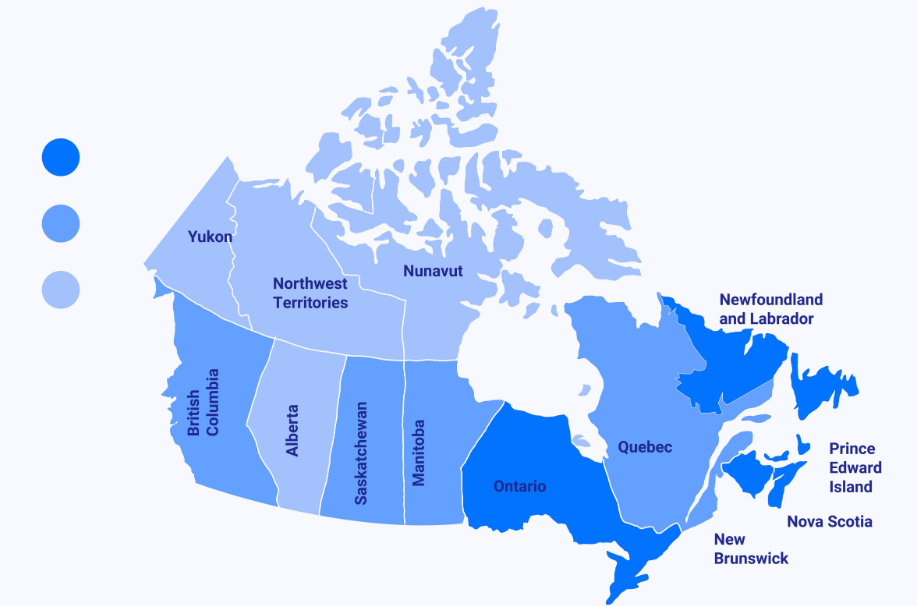
The Harmonized Sales Tax, or HST, combines the federal GST with a provincial component. HST applies in:
- New Brunswick
- Newfoundland and Labrador
- Nova Scotia
- Ontario
- Prince Edward Island
British Columbia, Manitoba, Quebec, and Saskatchewan impose separate provincial sales taxes in addition to the federal GST. Those provincial taxes may require separate registration, collection, filing, and payment. GST/HST Calculator and Rates [canada.ca]
When Must a Business Register for GST/HST?
A business generally must register when:
- It makes taxable supplies in Canada
- It no longer qualifies as a small supplier
For most businesses, small-supplier status depends on whether worldwide revenue from taxable supplies exceeds $30,000. Businesses that make only exempt supplies generally cannot register under the regular GST/HST system. When to Register for and Start Charging GST/HST [canada.ca]
The threshold generally includes revenue from taxable supplies made through the same legal entity, even when that entity operates under multiple business names.
How Does the $30,000 Threshold Work?
The effective registration date depends on how the business exceeds $30,000.
Exceeding $30,000 in One Calendar Quarter
If a business exceeds $30,000 in a single calendar quarter, it generally stops being a small supplier on the transaction that pushes it over the threshold.
GST/HST may therefore have to be charged on that transaction, not only on future sales.
Exceeding $30,000 Over Four Consecutive Quarters
If a business does not exceed $30,000 in one quarter but exceeds the threshold cumulatively over four consecutive calendar quarters, different effective-date rules apply.
The business does not necessarily have to register on the exact transaction that takes its rolling four-quarter revenue above $30,000. The small-supplier rules determine when its status ends and when tax collection must begin. Small Suppliers [canada.ca]
Businesses should monitor revenue:
- During each individual calendar quarter
- Across every rolling four-quarter period
Taxi and commercial ride-sharing operators have special registration requirements. Separate rules may also apply to non-resident businesses, digital-economy sellers, and marketplace operators. [canada.ca], [canada.ca]
Can a Business Register Voluntarily?
An eligible business may register before reaching the mandatory threshold.
Voluntary registration could make sense when the business:
- Has significant startup expenses
- Purchases equipment or inventory
- Expects to exceed $30,000 soon
- Works primarily with commercial customers
- Wants to claim eligible Input Tax Credits
Once registered, the business must collect GST/HST on taxable supplies and file a return for every reporting period, including periods with no sales. [canada.ca]
Voluntary registration should be considered carefully because it creates ongoing invoicing, bookkeeping, filing, and payment obligations.
GST/HST and Provincial Sales-Tax Rates in 2026
| Province or territory | GST or HST | Separate provincial tax |
|---|---|---|
| Alberta | 5% GST | None |
| British Columbia | 5% GST | 7% PST |
| Manitoba | 5% GST | 7% RST |
| New Brunswick | 15% HST | None |
| Newfoundland and Labrador | 15% HST | None |
| Northwest Territories | 5% GST | None |
| Nova Scotia | 14% HST | None |
| Nunavut | 5% GST | None |
| Ontario | 13% HST | None |
| Prince Edward Island | 15% HST | None |
| Quebec | 5% GST | 9.975% QST |
| Saskatchewan | 5% GST | 6% PST |
| Yukon | 5% GST | None |
These are the general rates published by the CRA. Special rules or exemptions can affect particular transactions. GST/HST Calculator and Rates [canada.ca]
Nova Scotia’s HST rate decreased from 15% to 14% on April 1, 2025. Businesses selling into Nova Scotia should confirm that their invoicing and e-commerce systems use the current rate. Charge and Collect GST/HST [canada.ca]
Which GST/HST Rate Should a Business Charge?
The applicable rate depends on the place-of-supply rules, not simply where the business is registered.
The correct rate may depend on:
- What the business sells
- Where goods are delivered
- Where services are supplied
- Where the customer is located
- Whether the supply is taxable, zero-rated, or exempt
- Whether a special rule applies
Place of Supply in a Province [canada.ca]
For example, a British Columbia business delivering goods to a customer in Ontario may have to charge Ontario’s 13% HST. The CRA similarly explains that goods delivered to Nova Scotia can be subject to 14% HST even when the seller operates from Manitoba. Charge and Collect GST/HST [canada.ca]
Professional services, digital products, software, real estate, transportation, and international transactions may require more detailed analysis.
What Is the Difference Between Taxable, Zero-Rated, and Exempt Supplies?
Taxable supplies
GST or HST is charged at the applicable rate. A registered business may generally claim eligible Input Tax Credits for related expenses.
Zero-rated supplies
GST/HST applies at 0%. The business does not collect tax from the customer, but eligible Input Tax Credits may still be available.
The CRA identifies basic groceries as an example of supplies taxable at 0%. Charge and Collect GST/HST [canada.ca]
Exempt supplies
GST/HST is not charged. A business generally cannot claim Input Tax Credits for expenses used to make exempt supplies.
Zero-rated and exempt supplies can both appear to have no tax on the invoice, but their Input Tax Credit treatment is different.
What Are Input Tax Credits?
Input Tax Credits, commonly called ITCs, allow a registered business to recover eligible GST/HST paid or payable on purchases used in its commercial activities.
Potentially eligible expenses can include:
- Commercial rent
- Office expenses
- Utilities
- Startup costs
- Legal and accounting fees
- Delivery and freight
- Fuel
- Maintenance and repairs
- Qualifying vehicle expenses
- Business travel
- The allowable portion of meals and entertainment
Eligibility depends on business use, applicable restrictions, and proper documentation. Input Tax Credits [canada.ca]
Supporting invoices may need to include:
- The supplier’s name
- The invoice date
- A description of the purchase
- The amount paid or payable
- The GST/HST charged
- The supplier’s registration number
- Applicable purchaser information
A bank or credit-card statement may prove that a payment occurred, but it may not contain enough information to support an ITC.
Personal purchases and expenses related to exempt activities generally do not qualify. Mixed-use expenses must be allocated reasonably between commercial and non-commercial use.
How Often Must a Business File?
A business may have an annual, quarterly, or monthly GST/HST reporting period.
The assigned frequency depends primarily on annual taxable supplies. In some situations, a business may elect to use a different or more frequent reporting period. The CRA provides Form GST20 for changing a reporting period. GST20 Election for GST/HST Reporting Period [canada.ca]
Typical deadlines include:
- Annual returns: Generally three months after fiscal year-end
- Quarterly returns: Generally one month after the reporting period
- Monthly returns: Generally one month after the reporting period
Special timing may apply to annual filers who are individuals with business income and a December 31 fiscal year-end.
Businesses should confirm their assigned reporting period and exact deadline through their CRA account.
Must a Business File a Nil Return?
Yes.
Once registered, a business must file a GST/HST return for every reporting period, even if it:
- Had no sales
- Had no business activity
- Collected no tax
- Has no net tax to remit
- Is closing its GST/HST account
A return with nothing to report is called a nil return. GST/HST Reporting Requirements and Deadlines [canada.ca]
Are GST/HST Returns Filed Electronically?
Most GST/HST registrants must file electronically for reporting periods ending in 2024 and later. The CRA identifies exceptions for charities and selected listed financial institutions. Limited case-by-case exemptions may also be available. GST/HST Reporting Requirements and Deadlines [canada.ca]
Electronic filing methods include CRA online accounts, GST/HST NETFILE, participating financial institutions, compatible tax software, and TELEFILE where available. How to File a GST/HST Return [canada.ca]
What Is the Quick Method?
The Quick Method is an alternative GST/HST calculation available to certain eligible businesses.
Instead of calculating net tax entirely under the regular method, the business applies an approved remittance rate to eligible GST/HST-included sales.
The method may simplify reporting, but it also restricts Input Tax Credits for many operating expenses. Separate treatment may remain available for certain purchases, including eligible capital property.
The Quick Method has:
- Eligibility restrictions
- Approved remittance rates
- A formal election
- Specific ITC rules
- Rules for maintaining and revoking the election
Quick Method of Accounting for GST/HST [canada.ca]
The Quick Method is not automatically better for every business. The expected result should be compared with the regular method before an election is made.
What Happens If a Business Registers Late?
Failing to register does not eliminate the underlying GST/HST obligation.
A business may have to:
- Determine the proper effective registration date
- Reconstruct previous sales
- Identify the correct place of supply
- Calculate tax that should have been charged
- File outstanding returns
- Pay tax that was never collected from customers
- Address applicable interest and penalties
Recovering the tax from customers afterward may be difficult, particularly when the sales occurred months or years earlier.
What Happens If a Return or Payment Is Late?
Late or unpaid GST/HST amounts can attract interest. A failure-to-file penalty may apply when a return is late and an amount is owing.
Separate penalties may apply for other types of non-compliance, including failures involving mandatory electronic filing or a CRA demand to file.
A business that cannot pay the full balance should still address its filing obligations. Delaying a return because payment is unavailable can add a filing problem to an existing payment problem.
Common GST/HST Mistakes
Canadian small businesses commonly make the following mistakes:
- Failing to monitor the rolling $30,000 threshold
- Using the wrong registration date
- Charging the wrong provincial rate
- Missing eligible Input Tax Credits
- Claiming personal purchases as business expenses
- Treating GST/HST collected as ordinary revenue
- Forgetting to file nil returns
- Ignoring PST, RST, or QST requirements
- Using outdated provincial rates
- Assuming an online marketplace handles every tax obligation
Proper bookkeeping is the foundation of accurate GST/HST reporting.
Businesses should record tax collected separately from revenue, retain complete supplier invoices, reconcile GST/HST accounts every reporting period, and separate taxable, zero-rated, and exempt sales.
Cross-Border and E-Commerce Businesses
Cross-border and e-commerce businesses may have additional GST/HST obligations.
Important considerations include:
- Where customers are located
- Where goods are stored or delivered
- Whether sales occur through a marketplace
- Whether the marketplace collects tax
- Whether the business makes direct sales
- Whether regular or simplified registration applies
- Whether inventory is held in Canada
- Whether provincial sales-tax registration is required
A marketplace collecting GST/HST on certain transactions does not necessarily eliminate all registration and filing obligations of the underlying seller.
Frequently Asked Questions About GST/HST
When must a small business register for GST/HST?
Most businesses must register when they stop qualifying as small suppliers and make taxable supplies in Canada. For most businesses, the key threshold is $30,000 in worldwide taxable revenue.
Do I charge GST/HST as soon as I reach $30,000?
Not always. The effective date depends on whether the business exceeds $30,000 in one calendar quarter or cumulatively over four consecutive calendar quarters.
Can I register before earning $30,000?
Yes. An eligible business may register voluntarily. It must then collect GST/HST on taxable supplies and file returns for every reporting period.
Which GST/HST rate should my business charge?
The rate depends on the place-of-supply rules. The type of sale, delivery location, customer location, and other factors may determine the applicable rate.
Can I recover GST/HST paid on business expenses?
A registered business may claim eligible Input Tax Credits for GST/HST paid or payable on purchases used in its commercial activities. Proper supporting documents are required.
Do I file a return if my business had no sales?
Yes. A registered business must file for every reporting period, including periods with no business activity. This is called a nil return.
Is GST/HST the same as PST or QST?
No. PST, RST, and QST are separate provincial sales taxes. Separate registration, filing, and payment obligations may apply.
What happens if my business registers late?
The business may be responsible for the GST/HST that should have been collected from the proper registration date, even if customers were not charged.
Does marketplace collection cover all my obligations?
Not necessarily. The seller may still have obligations related to direct sales, other platforms, imported goods, inventory in Canada, or provincial sales taxes.
How AccountingX Helps
AccountingX assists Canadian businesses with:
- GST/HST registration
- Effective registration-date reviews
- GST/HST return preparation
- Input Tax Credit reviews
- Quick Method comparisons
- Bookkeeping and account reconciliation
- Nil returns
- Late and multi-year filings
- E-commerce and marketplace sales
- QST and provincial sales-tax coordination
- Non-resident-owned corporations
- U.S.-Canada cross-border compliance
AccountingX has in-house CPAs in Canada and the United States, allowing the firm to coordinate GST/HST compliance with bookkeeping, corporate tax, and cross-border filing requirements.
Need Help With GST/HST?
If your business is approaching the $30,000 threshold, has already exceeded it, or is uncertain whether it charged the correct rate, AccountingX can help determine:
- Whether registration is required
- The correct effective registration date
- Which rate applies to your sales
- Whether returns are outstanding
- Which Input Tax Credits may be available
- Whether the bookkeeping supports the amounts claimed
- Whether additional provincial or cross-border filings apply
Contact AccountingX to review your business’s GST/HST obligations and determine what needs to be registered, corrected, or filed.
